How to Choose the Right Forklift Battery
If you operate forklifts in your business, the type of industrial battery you choose will have a major impact on your company’s overall efficiency. Whether you have just one lift truck or an entire fleet, your battery choice affects operational costs, productivity, and maintenance requirements for years to come.
This guide walks you through the different kinds of forklift batteries, their key differences, battery price ranges, and how these options impact your daily operations.
Forklift Battery Types: Lead-Acid vs Lithium-Ion
After determining which size battery is compatible with your forklift, the next critical decision is choosing between lithium-ion forklift batteries and lead-acid forklift batteries.
Electric forklifts are powered by one of these two main battery types. While other power options exist (propane, diesel, or gas), two-thirds of forklifts put into service each year are electric.
Lead-Acid Forklift Batteries
Lead-acid batteries have powered forklifts since the 1960s. They’re bulky, liquid-filled units with removable tops that generate electricity via a chemical reaction between lead plates and sulfuric acid. The technology dates back to 1859 and requires regularly refilling the units with water.

Reference diagram of traditional lead-acid battery structure for forklift applications
Lead-Acid Battery Specifications:
- Voltage options: 24V, 36V, 48V, or 80V (48V most common)
- Capacity range: 400Ah to 1,200Ah
- Weight: 2,400-3,800 pounds (48V 750Ah battery)
- Cycle life: 1,000-1,500 cycles
- Expected lifespan: 5-7 years
- Usable capacity: 80% (discharging below 20% damages battery)
Lithium-Ion Forklift Batteries
Lithium-ion batteries are newer technology, first used commercially in the early 1990s. Specifically, lithium iron phosphate (LiFePO4) chemistry has become the standard for material handling applications. These batteries are more compact and energy-dense than lead-acid units. The cells are sealed and require no water maintenance.
Looking for high-quality lithium forklift batteries? Check out our AGV Power Battery Series designed specifically for material handling equipment and forklift applications.

Professional 48V lithium forklift battery with advanced BMS and sealed construction
What’s Inside a Lithium Forklift Battery:

Internal structure diagram: cell configuration, BMS integration, and thermal management system
- LiFePO4 Cell Modules: Individual 3.2V cells connected in series (15 cells = 48V nominal)
- Battery Management System (BMS): Monitors every cell’s voltage, temperature, and current. Prevents overcharging, over-discharging, and thermal issues
- Thermal Management: Passive or active cooling keeps cells within optimal temperature ranges (15°C to 45°C)
- Protective Enclosure: IP65-rated housing provides dust-proof and water-resistant protection
- Communication Interface: CAN bus or RS485 connections enable charger communication
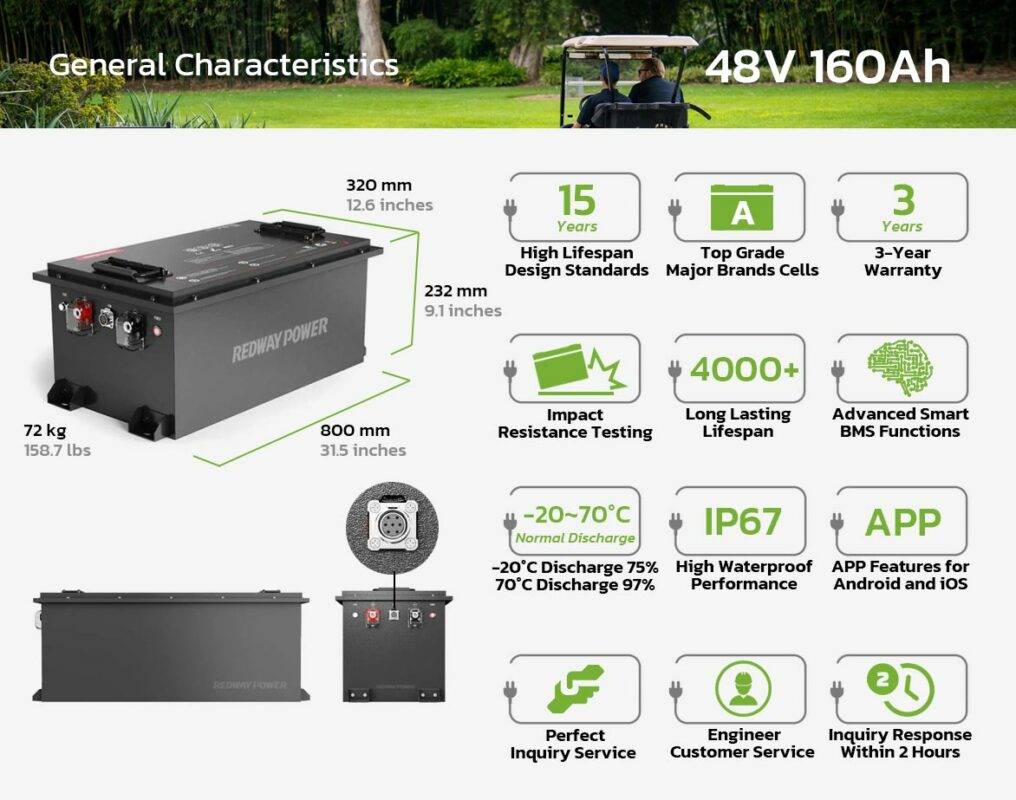
Technical specifications: voltage rating, capacity, dimensions, and performance parameters
Lithium-Ion Battery Specifications:
- Voltage compatibility: 24V, 36V, 48V, and 80V (drop-in replacements)
- Capacity range: 100Ah to 600Ah (100% usable capacity)
- Weight: 1,100-2,200 pounds (40-50% lighter than lead-acid)
- Cycle life: 3,000-5,000 cycles
- Expected lifespan: 8-12 years
- Maintenance: Zero—sealed system, no watering required
Length of Service Life
Which type of battery your operation uses determines replacement frequency:
- Lead-Acid: 1,000-1,500 cycles (5-7 years typical)
- Lithium-Ion: 3,000-5,000 cycles (8-12 years typical)
A lithium-ion forklift battery needs replacement less frequently, which drives many business owners to prefer them over conventional lead-acid batteries.
Maintaining Battery Capacity
Both battery types require proper care to perform at full potential. However, lead-acid batteries demand significantly more attention:
Lead-Acid Battery Maintenance Requirements:
- Equalizing (Cell Balancing): Required to break up sulfate crystals that form at bottom of cells. Neglected batteries may not recover
- Temperature Control: Must be kept within specific temperature range or service life decreases. Get very hot while charging, requiring temperature-controlled storage
- Fluid Level Management: Check water levels every 10 charging cycles. Missing this destroys batteries
Lithium-Ion Battery Maintenance Requirements:
- Automatic Equalization: BMS handles cell balancing automatically
- Wide Temperature Range: Function in -4°F to 140°F (-20°C to 60°C)
- No Fluid Management: Sealed system requires no water
Side-by-Side Comparison
| Feature | Lead-Acid | Lithium-Ion |
|---|---|---|
| Initial Cost | $4,500-$7,000 | $12,000-$20,000 |
| Cycle Life | 1,000-1,500 | 3,000-5,000 |
| Lifespan | 5-7 years | 8-12 years |
| Charging Time | 8 hours + 8 hour cooldown | 1-2 hours (no cooldown) |
| Charge Efficiency | 75-80% | 95-98% |
| Usable Capacity | 80% | 100% |
| Maintenance | Weekly watering, monthly equalization | None |
| Weight (48V 750Ah) | ~2,800 lbs | ~1,400 lbs |
| Multi-Shift Use | Requires 2-3 batteries per forklift | 1 battery with opportunity charging |
Forklift Battery Sizes
Forklift battery specifications vary substantially depending on which type of vehicle they’re powering. Battery packs are chosen based on equipment type and operational requirements.
Common Voltage Options:
- 24V forklift battery: End riders, center riders, walkie stackers, walkie pallet jacks
- 36V forklift battery: Narrow aisle forklifts, 3-wheel sit-downs, stand-up counterbalanced forklifts
- 48V forklift battery: Counterbalanced forklifts, 3-wheel sit-downs, sit-down counterbalanced forklifts
- 80V forklift battery: Large counterbalanced forklifts, heavy-duty equipment

Side-by-side comparison: lithium-ion vs lead-acid forklift battery performance and specifications
Critical Measurements You Need
- Length × Width × Height: Even one inch difference can mean the battery won’t fit
- Connector location and type: Top-mounted vs side-mounted terminals affect fit in tight compartments
- Battery weight: Critical for forklift stability and counterbalance—not just lifting capacity
- Mounting hole pattern: Must align with forklift’s tie-down system
How to Measure Your Battery Compartment
Step-by-step measurement process:
- Remove existing battery and measure battery tray opening (length, width, depth)
- Check for obstructions: cable routing, mounting brackets, safety bars, structural reinforcements
- Note connector position: top, side, or front mounting
- Check forklift’s data plate for minimum battery weight specification
- Measure overhead clearance for top-loading compartments
Voltage must match exactly. A 48-volt forklift requires a 48-volt battery. Using wrong voltage damages both battery and forklift electrical system.
Capacity Selection by Operation Type:
- 100-200Ah: Light-duty, single 8-hour shift, mostly travel with light loads
- 200-400Ah: Medium-duty, standard warehouse work, occasional two-shift operations
- 400-600Ah: Heavy-duty, continuous multi-shift operations, heavy loads
- 600Ah+: Industrial 24/7 operations, heavy manufacturing, cold storage
Forklift Battery Charging
How your battery recharges has major effects on operational efficiency. Lithium-ion batteries charge faster and with less complexity than lead-acid units.
Lead-Acid Charging Requirements
Official recommendation: 8 hours charging, 8 hours cooling, 8 hours use.
Reality in most warehouses: charge overnight, use all day, hope it lasts.
Lead-Acid Charging Specifications:
- Charge rate: 12-18 amps per 100Ah of capacity
- Charging time: Minimum 8 hours to 80-100% charge
- Cooldown requirement: 8 hours before optimal use (batteries reach 110-120°F during charging)
- Energy efficiency: 75-80% (20-25% wasted as heat)
- Equalization: Required monthly—controlled overcharge to balance cell voltages
Multi-Shift Battery Rotation:
- Shift 1: Battery A in use, Battery B charging, Battery C cooling
- Shift 2: Battery B in use, Battery C charging, Battery A cooling
- Shift 3: Battery C in use, Battery A charging, Battery B cooling
Result: You need three batteries and three chargers for every forklift in continuous operation—significant capital investment plus labor cost of battery changes (15-20 minutes per swap).
Lithium Opportunity Charging
Lithium batteries can be charged anytime, anywhere, for however long you have available. This isn’t marketing—it’s fundamental chemistry that changes warehouse operations.
Lithium Charging Advantages:
- Charge rate: 30-50 amps standard, up to 100+ amps with proper infrastructure
- Partial charge time: 1 hour = 50%, 2 hours = 80%
- No cooldown needed: Use immediately after charging
- Energy efficiency: 95-98%, minimal waste heat
- Opportunity charging: Charge during any break without harming battery life
Real-World Opportunity Charging Schedule:
Distribution center, two-shift operation (7am-11pm):
- 7:00am – Start shift at 95% charge
- 10:30am – 15-minute break, plug in → back to 85%
- 12:00pm – 30-minute lunch → back to 90%
- 3:00pm – Shift change, 30-minute charge → back to 95%
- 6:30pm – Evening break, 15-minute charge
- 11:00pm – End shift, overnight charge to 100%
Result: One battery per forklift, zero downtime for battery changes, continuous operation across both shifts.
Charger Compatibility
Critical: You cannot use a lead-acid charger on lithium batteries.
Why Lead-Acid Chargers Don’t Work With Lithium:
- Voltage mismatch: Lead-acid chargers output 2.35-2.50V per cell. Lithium needs precisely 3.65V per cell maximum
- Equalization mode: Lead-acid chargers periodically apply high voltage. This damages lithium batteries
- No communication: Lead-acid chargers can’t communicate with BMS
Lithium-Compatible Chargers Provide:
- CAN bus or RS485 communication with battery BMS
- Precise voltage control based on cell chemistry
- Temperature-compensated charging
- Charge current modulation based on BMS feedback
- Automatic shutoff when BMS signals full charge
Charger Costs (2026 Pricing):
- Lead-acid charger (48V, 25A): $1,800-$2,500
- Lithium-compatible charger (48V, 35A): $2,500-$4,000
- High-power lithium charger (48V, 80A): $4,500-$6,500
Forklift Battery Watering System
Lithium-ion batteries are sealed shut. The electricity-generating chemicals inside stay inside, requiring no liquid-related work by forklift operators.
Lead-acid batteries require an entire watering system that employees must follow if they want the battery to function well for its maximum service life.
Lead-Acid Battery Watering Requirements
The watering system involves:
- Only topping off with water when battery is fully charged and cooled down
- Refilling water often enough so top of lead plates never exposed (approximately every 10 charge cycles)
- Being careful not to overfill with water
- Leaving enough space for liquids to expand during use
- Use water between 5 and 7 on pH scale
Required Maintenance Tasks:
1. Watering (Weekly to Bi-weekly):
- Frequency: Every 5-10 charge cycles (weekly for daily-use forklifts)
- Time required: 15-20 minutes per battery for manual watering
- Labor cost: ~$25-35 per watering session at $75/hour labor rate
- Annual cost per battery: $1,300-1,800 in labor alone
2. Equalization Charging (Monthly):
Controlled overcharging that brings all cells to equal voltage. Requires additional 2-4 hours on charger and generates significant heat and hydrogen gas.
3. Cleaning and Inspection (Quarterly):
Battery tops must be cleaned of acid residue and corrosion. Terminals need inspection and retightening. Cable connections require checking for heat damage.
Lithium Battery Maintenance: Zero
Lithium batteries are sealed systems. No watering, no equalization, no cleaning, no specific gravity testing. The BMS handles everything automatically.
Only Recommended Maintenance:
- Visual inspection: Check for physical damage, loose connections (5 minutes quarterly)
- Terminal cleaning: Wipe terminals if corrosion appears (rare, maybe once yearly)
Maintenance Cost Comparison (per battery, per year):
- Lead-acid: $1,800-2,400 (mostly labor for watering)
- Lithium: $50-100 (occasional terminal cleaning)
- Annual savings per battery: $1,750-2,300
For a 20-forklift fleet: $35,000-46,000 in annual maintenance savings with lithium.
Forklift Battery Safety
Safety is critical when handling powerful battery systems. One battery type clearly offers advantages for typical workplaces.
Lead-Acid Battery Safety Hazards
Primary Hazards:
- Sulfuric acid: Battery electrolyte is 35-37% sulfuric acid. Skin contact causes chemical burns; eye contact can cause blindness
- Hydrogen gas: During charging, batteries release hydrogen gas. Above 4% concentration, hydrogen becomes explosive. Adequate ventilation is mandatory
- Heavy weight: A 48V battery weighs 2,400-3,800 pounds. Tip-over and drop incidents cause serious crushing injuries
- Electrical shock: 24V-80V DC can be lethal under certain conditions
- Arc flash: Accidental short circuits create intense heat and metal vapor causing severe burns
Required Safety Equipment:
- Eye wash station: Within 25 feet of charging area, tested weekly
- Acid spill kit: Sodium bicarbonate neutralizer, absorbent materials, disposal bags
- Ventilation system: Minimum 1 CFM per amp-hour of charge rate
- PPE: Face shield, acid-resistant gloves, rubber apron, safety boots
- Battery handling equipment: Overhead crane or extraction system rated for weight
- Fire extinguisher: Class D rated within 75 feet
Lithium Battery Safety
Lithium batteries are sealed—no potential for acid spills, corrosion, sulfation, or workplace contamination.
Key Safety Difference: Quality lithium batteries have built-in protection. The BMS continuously monitors every cell and shuts down battery if it detects:
- Over-voltage conditions
- Under-voltage conditions
- Over-current (charge or discharge)
- High temperature (typically >60°C)
- Low temperature (typically <-10°C)
- Cell voltage imbalance
- Short circuit conditions
Lead-acid batteries have no such protection—they’re just chemicals and lead plates. The BMS is what makes lithium batteries inherently safer for daily industrial use.
Forklift Battery Pricing
On the surface, lead-acid batteries seem like better investments. That’s true if you only look at initial cost.
When managers take a deeper look at total cost of ownership, they see a far different picture.
Upfront Costs
2026 Market Pricing (48V Forklift Batteries):
Lead-Acid (48V, 750Ah):
- Entry-level: $4,500-$5,500
- Premium brands: $5,500-$7,000
- Charger: $1,800-$2,500
Lithium (48V, 400Ah usable equivalent):
- Standard grade: $12,000-$15,000
- Premium brands: $15,000-$20,000
- Lithium-compatible charger: $2,500-$4,000
Total Cost of Ownership: 5-Year Comparison
For a single forklift running two 8-hour shifts (16 hours/day):
Lead-Acid Total 5-Year Costs:
- Batteries: $6,000 × 2 (need two for rotation) = $12,000
- Chargers: $2,500 × 2 = $5,000
- Electricity: $3,500/year × 5 = $17,500 (at 80% efficiency)
- Watering labor: $1,800/year × 5 = $9,000
- Battery change labor: $1,200/year × 5 = $6,000
- Floor space: $800/year × 5 = $4,000
- Maintenance supplies: $300/year × 5 = $1,500
Lead-Acid Total: $55,000 over 5 years
Lithium Total 5-Year Costs:
- Battery: $16,000 × 1 = $16,000
- Charger: $3,500 × 1 = $3,500
- Electricity: $2,000/year × 5 = $10,000 (at 97% efficiency)
- Maintenance labor: $100/year × 5 = $500
- Battery change labor: $0
- Floor space: $0
Lithium Total: $30,000 over 5 years
Net Savings with Lithium: $25,000 per forklift over 5 years
Payback period: approximately 2.2 years
When Lead-Acid Makes Financial Sense
Lead-acid remains the better choice in certain situations:
- Single-shift operations: Limited hours mean opportunity charging advantages don’t matter
- Budget constraints: Can’t allocate $15,000-20,000 upfront
- Seasonal operations: Forklifts sit idle for months at a time
- Older forklift fleets: Replacing forklifts within 2-3 years anyway
FAQs: Lithium-Ion Forklift Battery vs Lead-Acid Battery
A lithium-ion forklift battery is sealed, maintenance-free, and supports opportunity charging. Lead-acid batteries require regular watering, equalizing, and a ventilated charging space.
Lithium-ion batteries typically last 3,000+ charge cycles (8-12 years). Lead-acid batteries last 1,000-1,500 cycles (5-7 years). This makes lithium a better long-term investment.
Yes, in almost all cases. Lithium batteries are designed as “drop-in” replacements with same voltage configurations (24V, 36V, 48V, 80V) and similar dimensions. You need: (1) lithium-compatible charger, (2) appropriate battery weight (may need ballast), and (3) BMS compatibility verification.
No. Lead-acid chargers use different voltage profiles and lack communication capabilities lithium batteries require. Using a lead-acid charger will undercharge the battery or trigger BMS safety shutdowns. You need a lithium-compatible charger that communicates via CAN bus ($2,500-6,500).
For an 8-hour shift consuming 40 kWh at $0.12/kWh electricity rate:
Lead-acid: 40 kWh ÷ 0.80 efficiency = 50 kWh input × $0.12 = $6.00 per charge
Lithium: 40 kWh ÷ 0.97 efficiency = 41.2 kWh input × $0.12 = $4.94 per charge
Annual savings (250 working days): $265 per forklift. For 20-forklift fleet: $5,300/year in electricity savings alone.
Yes, when purchased from reputable manufacturers. Quality lithium batteries use LiFePO4 chemistry (thermally stable, resistant to thermal runaway). Built-in BMS monitors every cell and shuts down battery if unsafe conditions are detected. Lithium batteries eliminate two biggest lead-acid hazards: sulfuric acid spills and hydrogen gas generation.
Yes. Lithium batteries are ideal for multi-shift operations due to: fast charging (1-2 hours), no battery swaps needed, opportunity charging during breaks, and consistent power output. Lead-acid requires 2-3 batteries per forklift for multi-shift operations.
Yes. When battery reaches 100% charge, BMS signals charger to stop. Charger and BMS work together to prevent overcharging. Lithium batteries can remain connected indefinitely without harm—unlike lead-acid which can be damaged by continuous charging.