

Introduction: Understanding Industrial Batteries
Industrial batteries are engineered to deliver reliable power in demanding commercial and industrial environments. Unlike consumer batteries, industrial battery systems are designed for high capacity, long cycle life, and stable performance under continuous or heavy-duty operation.
They are widely used in manufacturing facilities, energy storage systems, telecom infrastructure, material handling equipment, backup power applications, and renewable energy integration. Selecting the right industrial battery is not simply about capacity —
it involves evaluating performance requirements, operating conditions, safety standards, and long-term cost efficiency.
Lithium-Ion Batteries (LiFePO4 and Other Lithium Technologies)
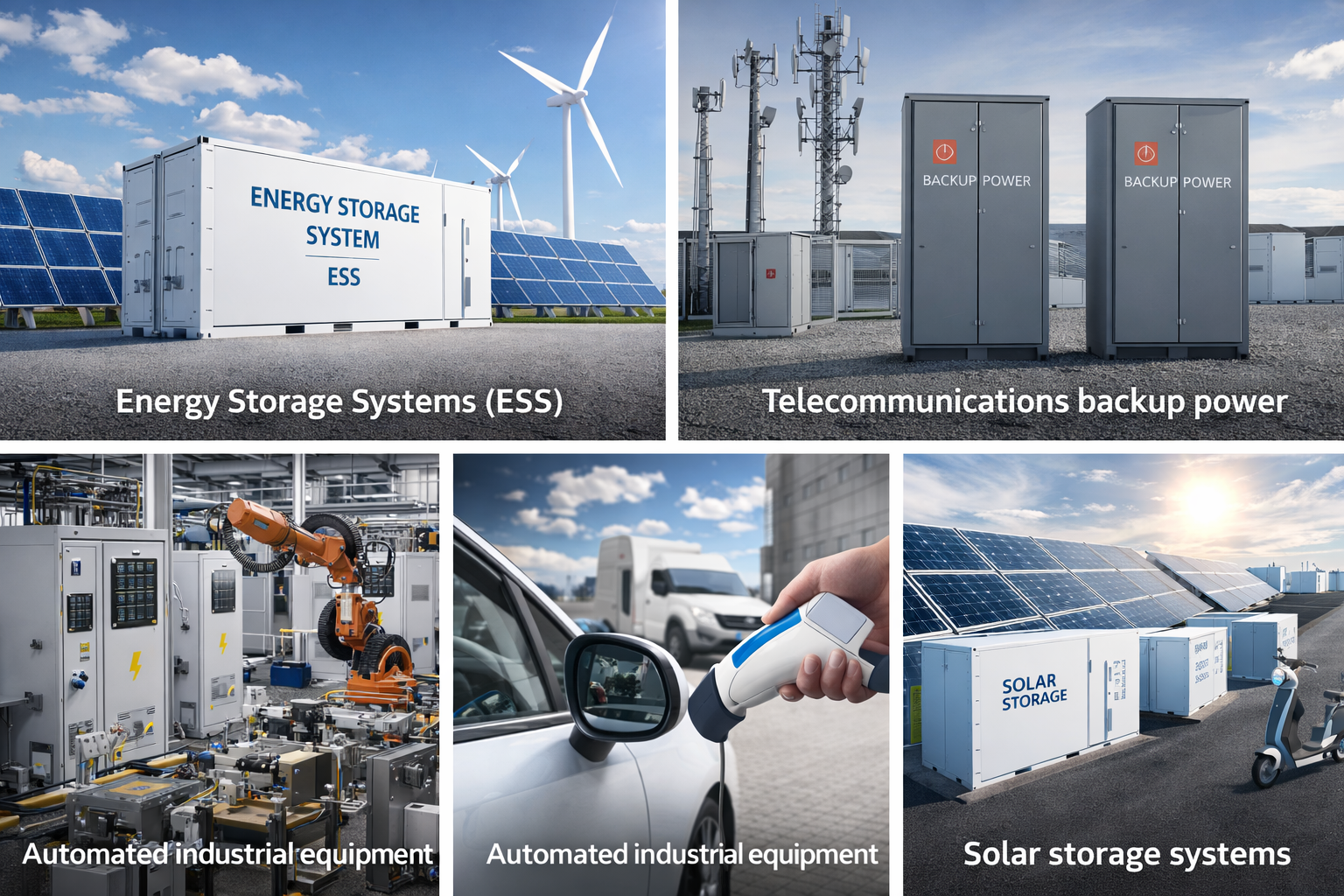
Lithium-Ion Batteries
Lithium-ion batteries, especially Lithium Iron Phosphate (LiFePO4), are ideal for high-efficiency, long-cycle industrial applications such as:
-
Telecommunications backup power
-
Automated industrial equipment
-
Solar storage systems
They offer:
-
High energy density
-
Long cycle life
-
Fast charging capability
-
Low maintenance requirements
-
High operational efficiency
Lithium batteries are particularly suitable for modern industrial systems that demand reliability, safety, and long-term cost efficiency.
Lead-Acid Batteries (AGM / Gel / Flooded)
Lead-acid batteries are commonly used in traditional backup systems and material handling equipment such as forklifts.
Advantages include:
-
Lower initial investment cost
-
Mature and widely available technology
However, compared to lithium batteries, they generally have:
-
Shorter cycle life
-
Higher maintenance requirements
-
Lower energy efficiency
-
Heavier weight and larger footprint
They may still be suitable for budget-sensitive projects or low-cycle applications.
Industrial Energy Storage Systems (Large-Scale Battery Systems)
Designed for large-scale industrial and commercial use, these systems integrate battery modules with control systems and protection mechanisms.
They are commonly used for:
-
Peak shaving
-
Load shifting
-
Grid support
-
Renewable energy integration
-
Factory energy management
These solutions focus on scalability, system integration, and long-term operational stability rather than individual battery cells.
Deep Cycle Batteries
Deep cycle batteries are designed for applications that require consistent, repeated discharge over long periods.
They are suitable for:
-
Renewable energy systems
-
Off-grid applications
-
Marine and RV systems
-
Continuous industrial power usage
Unlike starter batteries, deep cycle batteries are engineered to deliver stable power over extended durations without rapid degradation.
Evaluate Capacity and Power Requirements
Selecting the correct capacity and power configuration is critical to ensuring operational stability and efficiency.
Industrial applications vary significantly — some require long-duration energy supply, while others demand high burst power in short intervals. Understanding both energy capacity (kWh/Ah) and power output (kW) is essential.
Key factors to assess:
-
Total energy consumption per day
-
Peak load requirements
-
Continuous vs intermittent discharge
-
Future expansion needs
-
Backup duration requirements
Oversizing increases upfront investment, while undersizing leads to system instability and shortened battery lifespan. A properly engineered battery system should match both current operational needs and future scalability plans.
Consider Environmental and Operating Conditions
Industrial batteries often operate in challenging environments. Temperature extremes, humidity, dust, vibration, and installation space constraints can significantly impact performance and lifespan.
Before selecting a battery solution, evaluate:
-
Ambient temperature range
-
Indoor vs outdoor installation
-
Ventilation and cooling conditions
-
Exposure to vibration or mechanical shock
-
Available installation space
For example, lithium iron phosphate (LiFePO4) batteries perform better in wider temperature ranges and require less maintenance compared to traditional lead-acid batteries. Proper environmental assessment ensures safety compliance and long-term reliability.
Assess Safety, Certification, and Long-Term Reliability
Safety and compliance are non-negotiable in industrial applications. A high-quality battery system should include advanced protection mechanisms and meet international certification standards.
Important considerations include:
-
Battery Management System (BMS) integration
-
Overcharge / over-discharge protection
-
Short circuit and thermal protection
-
Fire safety design
-
International certifications (CE, UN38.3, MSDS, IEC standards, etc.)
Beyond certifications, evaluate:
-
Expected cycle life
-
Warranty terms
-
Manufacturer production capacity
-
Technical support availability
A reliable supplier with strong engineering support ensures stable performance throughout the product lifecycle and reduces long-term operational risks.
Evaluate Capacity and Power Requirements
Industrial applications vary significantly — some require long-duration energy supply, while others demand high burst power in short intervals. Understanding both energy capacity (kWh/Ah) and power output (kW) is essential.
Key factors to assess:
-
Total energy consumption per day
-
Peak load requirements
-
Continuous vs intermittent discharge
-
Future expansion needs
-
Backup duration requirements
Oversizing increases upfront investment, while undersizing leads to system instability and shortened battery lifespan. A properly engineered battery system should match both current operational needs and future scalability plans.
Consider Environmental and Operating Conditions
Industrial batteries often operate in challenging environments. Temperature extremes, humidity, dust, vibration, and installation space constraints can significantly impact performance and lifespan.
Before selecting a battery solution, evaluate:
-
Ambient temperature range
-
Indoor vs outdoor installation
-
Ventilation and cooling conditions
-
Exposure to vibration or mechanical shock
-
Available installation space
For example, lithium iron phosphate (LiFePO4) batteries perform better in wider temperature ranges and require less maintenance compared to traditional lead-acid batteries. Proper environmental assessment ensures safety compliance and long-term reliability.
Assess Safety, Certification, and Long-Term Reliability
Safety and compliance are non-negotiable in industrial applications. A high-quality battery system should include advanced protection mechanisms and meet international certification standards.
Important considerations include:
-
Battery Management System (BMS) integration
-
Overcharge / over-discharge protection
-
Short circuit and thermal protection
-
Fire safety design
-
International certifications (CE, UN38.3, MSDS, IEC standards, etc.)
Beyond certifications, evaluate:
-
Expected cycle life
-
Warranty terms
-
Manufacturer production capacity
-
Technical support availability
A reliable supplier with strong engineering support ensures stable performance throughout the product lifecycle and reduces long-term operational risks.
Conclusion
Choosing the right industrial battery is not just about price — it is about matching the battery technology to your operational needs.
Lithium-ion batteries offer higher efficiency, longer lifespan, and lower maintenance, making them ideal for modern industrial and energy storage systems.
Lead-acid batteries remain suitable for traditional or budget-sensitive applications but may involve higher long-term costs.
Large-scale energy storage systems are designed for commercial and grid-level applications, while deep cycle batteries support consistent and repeated discharge environments.
Before making a decision, always evaluate:
-
Required voltage and capacity
-
Expected cycle frequency
-
Environmental conditions
-
Space availability
-
Maintenance capability
-
Safety standards